

Let's be honest, a resume is a candidate's greatest hits album. It shows you the successes, the polished achievements, but it doesn't tell you how they'll perform live, on the job, when things get tough. An interview gives you a feel for their personality, sure, but what about the skills and cognitive wiring that truly predict success?
That’s where pre-employment assessments come in.

Think of pre-employment assessments as a diagnostic tool. While the resume shows you what a candidate has done, these tests show you how they think, problem-solve, and what they’re truly capable of doing. They give you a look under the hood, revealing the core competencies and behavioral traits that don't always come across in a 30-minute chat.
These tools provide the hard data needed to answer the single most important question in recruiting: Can this person actually do this job, and will they thrive here? In a market where every hire counts, leaning on gut feelings is a gamble that all too often leads to expensive mis-hires.
Assessments bring a much-needed dose of science to the art of hiring. By measuring specific, job-relevant skills, they create a more level playing field for every applicant. This helps minimize the unconscious bias that can easily slip into traditional interviews, allowing you to make hiring recommendations that are not just smarter, but also fairer and more defensible.
This shift toward data-backed hiring isn't just a trend; it’s a fundamental change in how the best teams are built. The benefits are clear and directly impact your bottom line.
To put it simply, here’s what incorporating assessments into your process does for a recruitment agency:
These advantages are why the market is booming.
The global pre-employment assessment tools market was valued at USD 1.8 billion in 2024 and is on track to hit USD 3.8 billion by 2033. This isn't just growth; it's a clear signal that companies are getting serious about using objective data to win the war for talent. You can read more about the pre-employment assessment market surge.
Ultimately, pre-employment assessments give recruitment agencies a powerful advantage. They help you move with greater precision, turning the often subjective art of hiring into a more predictable science. This ensures you’re not just filling seats—you’re delivering future top performers who will make a real impact on your clients' businesses.
Not all pre-employment assessments are the same. Just as a doctor wouldn't use a stethoscope to check your vision, a recruiter shouldn't use a one-size-fits-all test for every single role. Getting to know the different types of assessments is the first real step toward building a hiring process that's targeted, effective, and fair.
Think of each category as a specialized lens. Each one brings a different part of a candidate's abilities into sharp focus, giving you a much clearer picture than a resume alone. Let’s break down the four main types you’ll come across.
Cognitive ability tests are all about measuring a candidate's mental horsepower. They don't test what someone knows, but rather how they think, learn, and solve problems on their feet. These have proven to be powerful predictors of job performance, especially for roles that demand quick learning and complex decision-making.
These tests get at core abilities like:
For instance, you'd want a marketing analyst to take a numerical reasoning test to see if they can truly interpret campaign data. If you want to go deeper on this, a common component is a deductive reasoning skills test, which is a great way to gauge analytical thinking.
While cognitive tests measure potential, skills assessments measure what a candidate can do right now. These are practical, hands-on tests that prove a candidate has the specific hard skills needed to hit the ground running. They cut right through the fluff on a resume and give you concrete proof of their abilities.
A skills assessment is the ultimate "show, don't tell" moment in hiring. It replaces a candidate's claims of expertise with real, demonstrable ability.
Think about it in these practical terms:
These assessments are direct and completely job-relevant, making them one of the cleanest ways to vet technical qualifications. A candidate’s score here is a strong signal of their immediate value, and you can learn more about how to apply smart candidate scoring for technical talent in our guide.
What really drives a candidate? How do they react under pressure, work with a team, or organize their day? This is where behavioral and personality tests come in, helping you uncover those crucial soft skills and workplace tendencies. They're all about figuring out if a person's natural style will mesh well with your team and company culture.
There are no "right" or "wrong" answers here. Instead, these tests map out a candidate's natural inclinations—things like their level of extraversion, conscientiousness, or how open they are to new ideas. For a sales role, you might be looking for someone with high resilience and persuasiveness. For an accountant, that same test would highlight conscientiousness and a sharp eye for detail as key strengths.
Job simulations are the closest you can get to a "try before you buy" in hiring. These assessments drop a candidate into a realistic work scenario and ask them to react just as they would on the job. This could be a role-playing exercise for a customer service rep or a complex case study for a management consultant.
A really popular version of this is the Situational Judgment Test (SJT). An SJT might pose a dilemma like, "You just found a major error in a report that’s due to a key client in one hour. What do you do?" The path they choose reveals their judgment, priorities, and problem-solving style under real-world pressure. They're especially useful for leadership and client-facing roles, where navigating tricky interpersonal dynamics is part of the daily grind.
Picking the right pre-employment assessment isn't about finding the most difficult or popular test out there. It's about precision. Think of it like a doctor choosing a diagnostic tool—you wouldn’t order an MRI for a common cold. The goal is to match the assessment directly to the core demands of the job so you’re measuring what actually drives success.
This process always begins with a real, hard look at the role. Forget the generic job description for a minute and ask the tough questions. What does a star performer in this position actually do all day? Are they wrestling with abstract problems and complex data, or are they executing specific, technical tasks with razor-sharp accuracy? The answer to that question is your starting point.
Before you even think about which test to use, you have to break the job down into three fundamental areas: thinking, skills, and behavior. This simple framework is your roadmap. It clarifies what you need to measure and stops you from using a one-size-fits-all test for a role that needs a custom fit.
This decision guide helps visualize how to map a role’s needs to the right assessment category, steering you toward the best way to measure thinking, skills, or behavior.
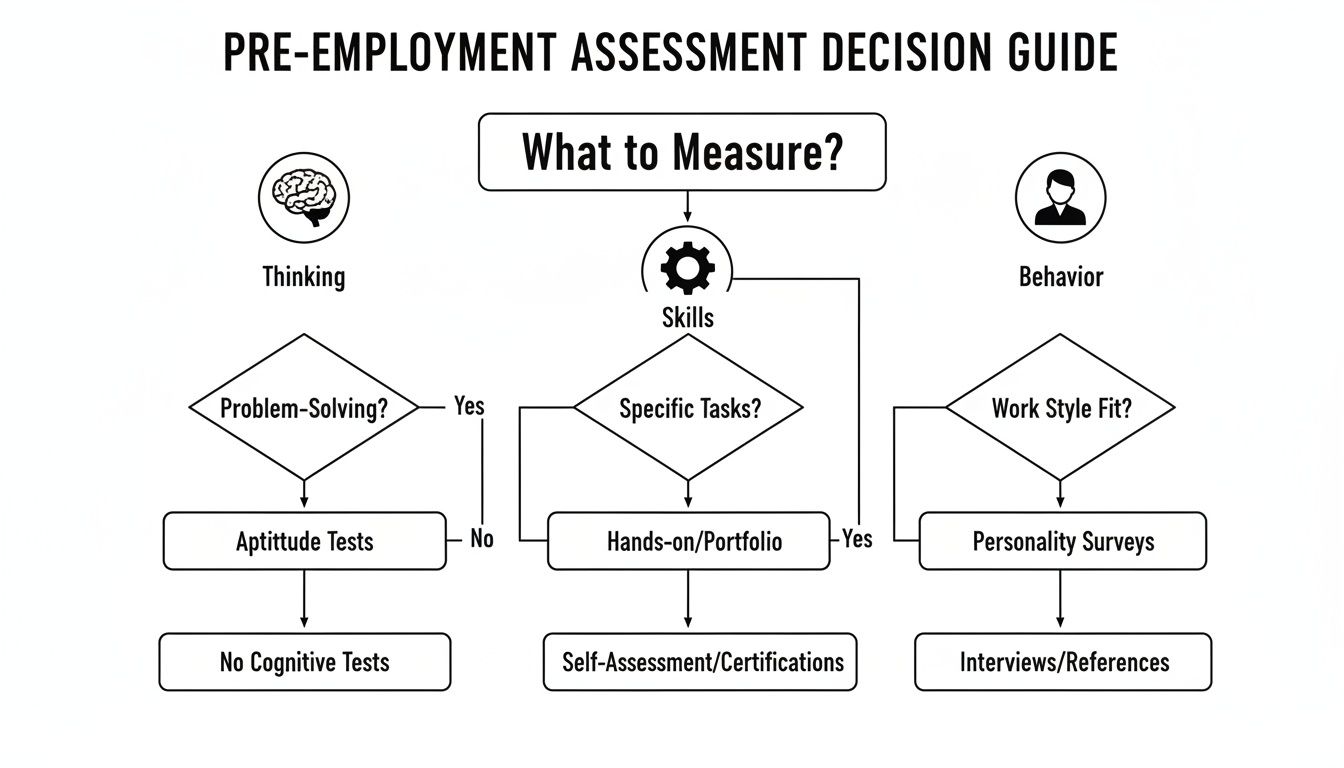
As the flowchart shows, the first step is always to define what you need to measure. Once that's clear, the right type of assessment becomes obvious.
One of the most common missteps is using the same assessment for a junior coordinator and a senior director. It just doesn’t work. The scope and complexity of the role have to dictate your choice.
For an entry-level position, a basic skills test is often all you need to confirm they have the foundational knowledge. But for a leadership role? You’ll get far more insight by combining a cognitive test with a situational judgment exercise that mimics real-world leadership challenges. Our guide on how to identify high-potential employees digs deeper into spotting the people ready for that next step.
Here’s how that looks in practice:
The demand for this kind of tailored, skills-first hiring is exploding. The global market for pre-employment testing software is on track to hit USD 6 billion by 2025, growing at a blistering 16.61% CAGR. Companies are realizing that gut feelings aren't enough. You can see more on the growth of pre-employment testing software and why this shift is happening so quickly.
Don’t just test for the job they'll do on day one. For critical roles, test for the potential they’ll need on day 365. An assessment should measure not just current skills, but also the capacity to grow and adapt to future challenges.
By thoughtfully breaking down the role and matching your tools to its seniority, you can build a truly strategic assessment plan. This data-driven approach pulls you out of the world of guesswork and into a repeatable, reliable system for finding top talent perfectly suited for any position.
To make this even more practical, here’s a quick-reference table to help you pair the right assessments with common job families. Think of this as a cheat sheet for getting started.
This table isn’t exhaustive, but it provides a solid foundation. The key is to always start with the most critical requirements of the role and choose the tool that measures that requirement most directly.
An assessment is only useful if you know how to use it. Just dropping a test into your hiring process without a clear plan is like adding a turbocharger to a car that has no steering wheel. You’ll definitely go faster, but you probably won't end up where you intended.
To get real value, you have to weave these tools into your recruitment workflow with purpose. It’s not a question of if you should use assessments, but when. The timing is everything, as it completely changes the test's purpose and its impact on your hiring funnel.
There are really two key moments to deploy an assessment, each with its own strategic advantages.
Using an assessment right after someone applies is a fantastic way to handle high-volume roles. Think of it as an automated first filter. It objectively flags candidates who have the basic, must-have skills before a human ever has to look at a resume.
This top-of-funnel approach works wonders for roles where:
Automating this first pass frees up your team to spend their time on what matters most: engaging with the best-qualified people. If you're looking to make this part of your process even more efficient, it's worth understanding the benefits of an automated resume screener to complement this strategy.
The other option is to send an assessment after an initial screen or first interview. This strategy is much better suited for more senior or complex roles where the applicant pool is smaller and you're trying to validate what you’ve already seen on paper or heard in a conversation.
Here, the assessment acts as a data-driven gut check. It’s your chance to dig deeper into a promising candidate’s problem-solving style, personality traits, or leadership potential before you commit to the final, most time-intensive interview stages. It’s less about weeding people out and more about validating who you should move forward with.
Pre-employment assessments should complement, not replace, human judgment. Use them to gather objective data that enriches your conversations and confirms your instincts, leading to more confident hiring decisions.
The pandemic really lit a fire under the adoption of these tools. With everyone suddenly working from home, companies needed reliable virtual ways to vet candidates, and that demand hasn't slowed down.
Let's be clear: how you handle the assessment process says a lot about your company. A clunky, confusing, or ridiculously long test can easily scare away great candidates. The solution is simple: clear, proactive communication that sets expectations from the very beginning.
Here are three simple rules for a better candidate experience:
Bringing pre-employment assessments into your hiring process is a fantastic way to add objectivity, but it's not a free-for-all. It comes with a serious responsibility to keep things fair and legally sound. This isn't about being scared of lawsuits; it's about building a solid, equitable process that protects your agency, your clients, and every single candidate.
Think of assessments as powerful tools. In the right hands, they build great things. In the wrong hands, they can cause a lot of damage. When used correctly, they are one of your best weapons against hiring bias. Used carelessly, they can actually create new risks. The trick is to know the rules of the road before you start driving.
One of the first concepts you need to get your head around is adverse impact. Put simply, this is what happens when one of your hiring practices—including an assessment—accidentally screens out a much higher percentage of candidates from a protected group (like those based on race, gender, or age). The intent doesn't matter; the outcome does.
The U.S. Equal Employment Opportunity Commission (EEOC) has clear guidelines here. If an assessment leads to adverse impact, the burden is on you to prove that the test is job-related and a business necessity. This is precisely why grabbing some random quiz off the internet is a terrible idea. You need to use scientifically validated, professionally developed tests.
An assessment score should never be the only reason you say "no" to a candidate. It's just one piece of the puzzle. You have to look at the whole picture—interviews, experience, references—to make a sound, defensible decision.
You don't need a law degree to build a fair and compliant assessment strategy. Sticking to a few core principles will help you minimize bias and make your process both effective and equitable.
Here’s a straightforward checklist to keep you on the right path:
Beyond the assessments themselves, remember that a comprehensive UK pre-employment checking process is also a key part of the legal framework, covering things like right-to-work status and other critical background details.
This push for fairness isn't just a U.S. thing; it's happening all over the world. In Europe, for instance, strict labor laws and GDPR have driven a huge demand for compliant and customizable assessment platforms, especially in places like Germany and the U.K. You can dig deeper into the global pre employment assessment tools market to see how these trends are playing out.
Ultimately, by making fairness, consistency, and validated tools your top priorities, you can use assessments to build incredible, diverse teams—all while keeping your agency safe from legal headaches.

So, how do you prove that assessments are a smart investment and not just another expense? The key is measuring their return on investment (ROI). If you want to get buy-in from clients or leadership, you need to speak their language—and that language is almost always about financial and strategic value.
Moving away from gut-feel hiring is about more than just making better placements. It’s about showing a real, tangible impact on the business. When you have the right metrics, you can shift the conversation from "how much does this cost?" to "look at the value this creates."
Let's get right to it. The financial impact of your assessment strategy comes down to a few core metrics. These are the numbers that directly link your hiring process to the company's bottom line.
Here’s what you should be tracking:
To get a clear financial picture, just compare these metrics before and after you started using assessments. For a great framework on how to run these numbers, check out our guide on how to calculate cost per hire.
While the numbers are convincing, the true impact of pre-employment assessments goes way beyond a spreadsheet. These are the benefits that build your reputation and cement your status as a go-to talent partner.
The real value of an assessment isn't just in the candidates it screens out, but in the confidence it gives you in the candidates you screen in. It provides objective validation that builds trust with hiring managers and clients.
These intangible returns are incredibly important:
With 40% of global organizations planning to add staff in Q1 2026, the pressure to hire well and hire fast is only going to grow. Assessments are no longer a "nice-to-have"—they're becoming essential for agencies that want to stay competitive and deliver both speed and quality.
Even the best-laid plans run into real-world questions. When you start weaving pre-employment assessments into your process, a few common hurdles always pop up. Let's tackle some of the most frequent ones recruiters ask.
There's no single right answer, but aim for the sweet spot: 20 to 60 minutes. You're walking a fine line between getting the data you need and respecting the candidate's time. Push it too far, and you'll see great people drop out of your process.
The key is to match the assessment's length to the job's complexity. A quick 15-minute skills test might be all you need for an entry-level role. But for a senior leadership position? A more comprehensive 45-minute blend of cognitive and personality tests is perfectly reasonable.
A candidate's time is a valuable commodity. A thoughtful assessment process signals that you respect it, which speaks volumes about your agency and your client's brand. The goal is a thorough evaluation, not a test of endurance.
Not a chance. Assessments are there to supercharge your interviews, not replace them. Think of them as a fantastic tool for gathering objective data that makes your conversations smarter and more targeted. They simply can't capture the human element.
Here’s how they work together:
The real magic happens when you use the assessment results to shape your interview questions. You move from generic questions to truly insightful conversations.
First off, don't panic. A poor test score from a candidate who looks great on paper isn't an automatic "no." It's a sign to dig deeper. Remember, an assessment is just one piece of the puzzle.
Treat a low score as a flag, not a verdict. It’s a prompt to get curious. During the interview, you can open a conversation around it. Try something like, "The assessment flagged X as a potential challenge. Could you walk me through how you've handled that in past roles?"
This turns a potential red flag into a chance for an honest discussion. You might uncover test anxiety, an off day, or simply an area for future development. It allows you to make a decision based on the whole person, not just a single score.
Ready to stop guessing and start hiring with confidence? Tapflow is the AI co-pilot that helps recruitment agencies source, screen, and select top talent faster. See how our smart sourcing and candidate ranking can transform your workflow at https://www.tapflow.app.


.svg)