
An automated resume screener is software that uses artificial intelligence to read, sort, and rank job applications against a specific set of requirements. Think of it as a super-fast digital assistant that can sift through a mountain of resumes in minutes, flagging the best ones so you can focus on the human side of recruiting.
Let's be honest, the modern hiring landscape is a flood of applications for every single open role. One-click apply buttons and job bots have cranked up the volume to an insane level, turning the hunt for a great candidate into a search for a needle in a digital haystack.
This sheer volume makes traditional manual screening a recipe for burnout. Recruiter fatigue is real. When you're staring at your 100th resume of the day, it's nearly impossible to give each one the focus it deserves. Good people get missed, unconscious bias creeps in, and the whole process grinds to a halt. It’s not just slow—it's broken for the scale we operate at today.
This is where an automated resume screener stops being a "nice-to-have" and becomes a core part of your toolkit. These systems are built to chew through high-volume, repetitive work with a speed and consistency that humans just can't match. They don't get tired, they don't have bad days, and they measure every single application against the exact same criteria.
The impact is immediate and measurable. To get a clearer picture, let's look at the two approaches side-by-side.
This table breaks down the core differences between the old way and the new way of handling the top of the hiring funnel.
The data backs this up. AI screening tools can slash resume review time by a staggering 75%, empowering recruiters to handle 10 times more candidates without burning out. With nearly 40% of all applications now getting an initial look from AI, companies are seeing their cost-per-hire drop by 30% and their time-to-fill shrink by 25%.
Even better, over 54% of teams using AI report finding better-fit candidates, which helps cut long-term turnover by 35%.
By automating the most time-draining part of the process, agencies can turn a chaotic manual slog into a streamlined pipeline of pre-qualified talent. This frees up your team to do what they do best: build relationships, hold meaningful conversations, and close top-tier candidates.
This isn't just about saving a few hours. It’s a strategic move you need to make to stay competitive. As hiring gets tougher, agencies clinging to manual methods will get left behind. The ability to quickly and accurately spot the best talent is what gives you an edge. To dive deeper into this shift, check out our analysis on why recruitment agencies that automate will outperform in 2025.
Now, let's get into the nitty-gritty of how these screeners actually work and how your agency can start using them to hire faster and smarter.
To really get what makes an automated resume screener tick, you have to look under the hood. This isn't some black-box magic; it’s a smart combination of technologies built to understand human language and spot patterns—often with more focus and consistency than a recruiter juggling ten things on a Friday afternoon.
At its heart, a modern resume screener is a specialized form of Intelligent Document Processing (IDP). It all starts with a technology called Natural Language Processing (NLP).
Think of NLP as a digital research assistant. If you give the assistant a stack of reports, they don’t just count the words; they pull out the key findings, identify the main arguments, and summarize the important data. NLP does the same for a resume. It reads and actually comprehends the language, extracting crucial info like:
This is worlds away from the clunky keyword-matching tools of the past. The difference is night and day, as you can see below—it’s the shift from a chaotic paper-chase to a clean, data-first strategy.
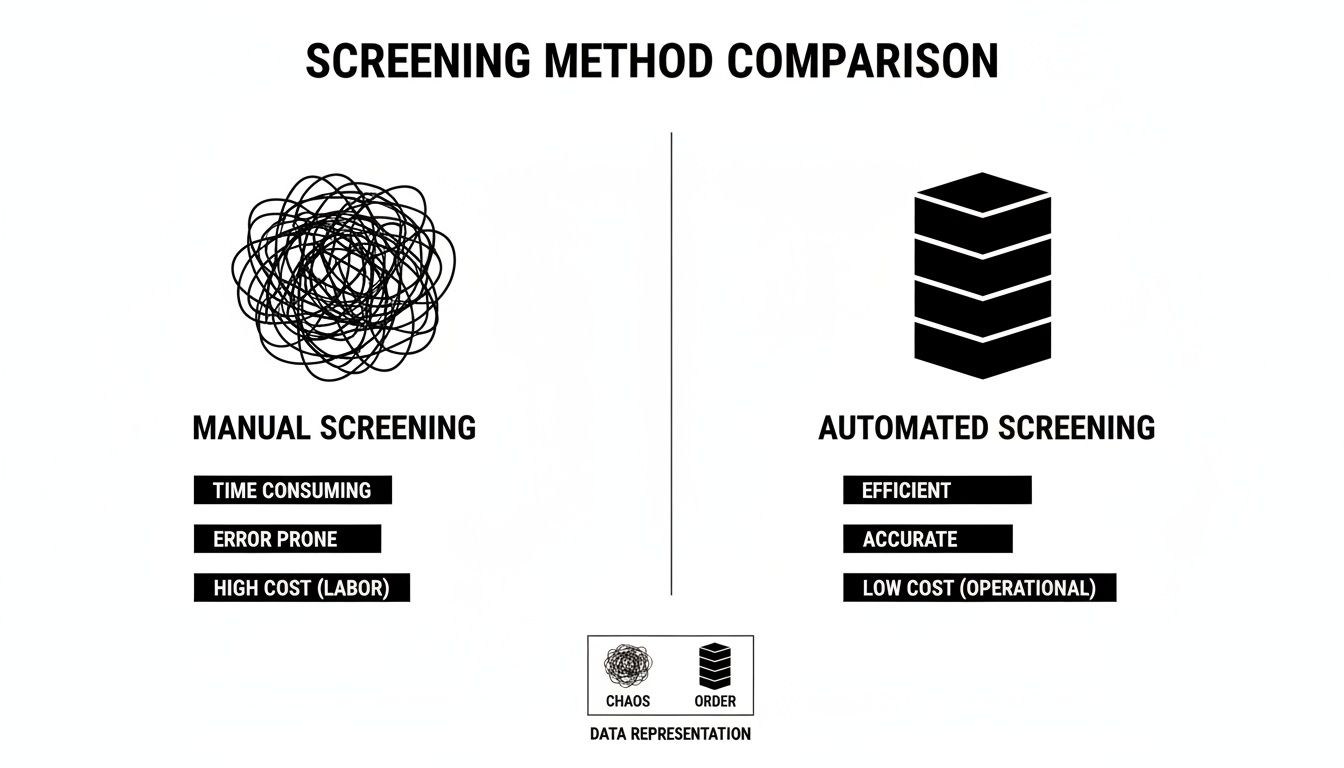
This visual says it all. Automation brings order to the chaos, letting your team spend its time on the candidates who actually have a shot.
If NLP is the reader, Machine Learning (ML) is the brain.
Imagine hiring a junior recruiter. On day one, you have to walk them through exactly what a great Senior Software Engineer looks like for your top client. You review resumes together, pointing out the good, the bad, and the "maybe."
After a few weeks, they start picking up on the patterns themselves. They learn which company experience really matters, what a solid career jump looks like, and which skills are non-negotiable. That’s exactly how ML works in an automated screener. It learns from your team's real-world decisions—who gets an interview, who gets an offer, and who gets a polite "no"—to constantly refine its definition of a perfect match.
An AI-powered screener becomes a smart apprentice that continuously learns from your team's expertise, getting better and more accurate with every single placement you make.
This is what makes modern tools so powerful. They aren't just following a rigid checklist; they're adapting to your agency's unique eye for talent.
The biggest leap forward has been the jump from simple keyword searches to semantic analysis. Old systems were frustratingly literal. They'd search for "project management," and if a fantastic resume used a phrase like "led cross-functional initiatives" or "oversaw project lifecycles," it would get tossed aside.
Semantic analysis, on the other hand, understands context and meaning. It knows those phrases are all talking about the same core competency. This is a complete game-changer for unearthing hidden gems. It finds you incredible candidates who just happen to describe their experience a little differently, making sure you never miss out on top talent because of a buzzword mismatch.
This shift is so critical, we wrote a whole guide on it. You can learn more about how AI moves from keywords to context, disrupting traditional recruiting.
By weaving these technologies together, an automated resume screener can read, interpret, and rank hundreds of resumes with a level of detail and consistency that's just not humanly possible. It’s the competitive edge your agency needs.

Let’s get real. Bringing an automated resume screener into your agency isn't about chasing the latest tech trend. It's about a fundamental upgrade to how you operate—one that directly boosts your bottom line, makes clients happier, and frees up your team to do their best work.
The first thing you’ll notice? Your recruiters get their day back. We all know manual screening is a soul-crushing time sink, with hours vanishing into a pile of unqualified applications. Automating that first pass gives your team back their most valuable asset: time.
That reclaimed time gets funneled directly into what actually matters—building relationships with A-list candidates, engaging passive talent, and ultimately, closing more placements for your clients. You're shifting focus from low-value admin to high-impact, revenue-generating work. It's no wonder AI adoption in recruiting is skyrocketing, jumping from just 26% of organizations in 2021 to a predicted 87% by 2025. Smart tools help recruiters fill roles 30-50% faster, a game-changer when your clients need results yesterday. You can find more on this trend and other predictions in this piece from shortlistd.io.
Here’s an advantage that’s easy to miss but incredibly powerful: AI’s knack for finding "hidden gems." Human recruiters, even with the best intentions, carry unconscious biases. We might gravitate toward candidates from big-name companies or prestigious universities, accidentally overlooking someone with a non-traditional but highly relevant background.
An automated resume screener, on the other hand, is completely objective. It measures every single application against the same set of core criteria—skills, experience, and qualifications. No biases, no favorites. This impartiality often brings incredible candidates to the surface who would have otherwise been missed.
By taking human bias out of the initial screening, you’re not just being fair—you’re ensuring you see a richer, more qualified talent pool. This almost always leads to a better quality of hire.
This data-first matching also ensures candidates aren't just a keyword match, but a genuine fit for the role's true needs. Better alignment right from the start means higher employee satisfaction and retention down the line, a stat that makes your agency look fantastic to clients.
Let's talk money. Automation has a direct and positive impact on your agency's financial health in two key ways.
When you add it all up, the return on investment becomes crystal clear. The initial software cost is quickly paid back by the time saved and the increased value you deliver. We dive deeper into this in our guide on how AI recruitment reduces time-to-hire.
Finally, automation is the key to sustainable growth. For most small and mid-sized agencies, the biggest hurdle to taking on more clients is pure bandwidth. An automated screener shatters that ceiling.
Suddenly, your team can handle a flood of applications that would have once required a much larger staff. This newfound scalability means you can confidently go after those bigger clients and more ambitious contracts without bloating your overhead. It's how you grow your revenue and market share while keeping your team lean and hyper-effective.
Let's be honest. Jumping into automated resume screeners means taking a hard look at the potential pitfalls. These tools are incredibly efficient, no doubt, but they also bring some serious ethical questions to the table. To build real trust with clients and candidates, every agency has to get this part right.
The biggest elephant in the room? Algorithmic bias.
Think of an AI model like a student learning from a textbook. If that textbook is full of outdated, biased information from decades past, what do you think the student will learn? They’ll just repeat the same mistakes. It's the same with AI. If you train it on your agency's historical hiring data—which might be packed with years of unconscious human biases—the AI will learn those patterns and replicate them, only much faster.
For example, if your past hires tended to come from a handful of specific universities, the AI might start automatically down-ranking perfectly qualified candidates from other schools. This doesn't just shrink your talent pool; it opens your agency up to some pretty serious legal and reputational risks.
The good news? You can absolutely manage these challenges. The goal isn't to shy away from automation but to use it thoughtfully. Fairness and accuracy don't just happen on their own; you have to build them into your process from day one.
Here’s how you can keep bias in check:
The most important piece of the puzzle is keeping a human-in-the-loop. Your automated resume screener should be your co-pilot, not the pilot. It’s there to surface great candidates and provide data-backed suggestions, but the final, nuanced decision always has to be made by a human recruiter.
Beyond bias, data privacy is another huge ethical hurdle. You're handling sensitive candidate information, and adding an automated tool means you have an even greater responsibility to protect it.
Make sure your screening system and your internal processes are fully compliant with data protection laws like GDPR. This means being upfront with candidates about how their data is being used and processed by an automated system. That kind of transparency is what builds trust.
Finally, never let efficiency kill the human touch. The process can't feel cold or impersonal. Candidates deserve timely updates and clear communication, even when things are automated. A well-designed system makes the whole journey smoother for everyone, leaving candidates with a positive impression—even if they don't get the job.
By balancing powerful tech with smart human oversight, you can get all the benefits of automation without sacrificing the ethical standards that define your agency.

Rolling out an automated resume screener doesn't have to be a massive, disruptive overhaul. When you do it right, it’s a smooth, strategic upgrade to your workflow. The secret is to start with a clear plan, beginning with a simple question: what problem are we actually trying to solve?
Before you even glance at a demo, define your primary goals. Are you drowning in a sea of applications? Is your time-to-fill metric dragging? Or do you have that nagging feeling that amazing candidates are slipping through the cracks? Nailing down your main pain point will steer every decision you make, from which tool you choose to how you measure its success.
Once you’ve figured out your "why," you can get to the "what." Picking the right automated resume screener is a big deal, and it’s about a lot more than just a slick interface. You need a tool that fits the way your agency works.
Here are a few non-negotiable features to look for:
After you've got a shortlist, the next step is connecting it to your current setup. This is where a lot of agencies get nervous, but a good screener should feel more like a plug-in than a full system replacement. The integration usually involves connecting APIs, which lets the new tool pull job requirements from your ATS and push ranked candidates right back into it.
A successful implementation feels less like major surgery and more like adding a powerful new instrument to your toolkit. It should enhance your existing workflow, not force you to start from scratch.
Instead of flipping a switch for the whole company, start small. A pilot program is hands-down the best way to introduce an automated resume screener. Pick one or two tech-savvy recruiters and a handful of roles to test the system on. This approach keeps the risk low and gives you a controlled space to work out any kinks.
A pilot program lets you:
This method builds momentum and proves the tool's value fast, making the full rollout a much smoother ride. For a deeper look at the nuts and bolts of getting a system like this up and running, check out this guide on Mastering Automated Resume Screening Software.
Finally, remember that training is more about building trust than teaching clicks. Show your team how the tool helps them hit their targets and frees them up to focus on strategy and building relationships. Frame the AI as a co-pilot, designed to make their expertise even more powerful. And if you're looking for more ways to bring this kind of support into your process, our guide on how to use AI in recruiting has plenty of other ideas.
After digging into the world of the automated resume screener, one thing is crystal clear: this isn't some far-off sci-fi concept anymore. It’s a core tool for any recruitment agency that wants to stay competitive. We're witnessing a fundamental shift in how we find talent, moving away from tedious manual work and toward a smarter, data-backed strategy.
The future of hiring isn’t about replacing recruiters with robots. It’s about giving them an intelligent co-pilot.
The real goal of AI in recruiting is to amplify human expertise. By letting the machine handle the high-volume, repetitive grind of initial screening, your team gets to focus on what people do best: building relationships, thinking strategically with clients, and navigating the delicate art of the offer.
For small and mid-sized agencies, this shift is a lifeline. You need tools that don't just save you a few hours but actively help you find better candidates and grow your business without having to triple your staff. This is exactly where a platform like Tapflow slots in. It's built to be a co-pilot, putting powerful AI right at your fingertips.
Think about it. Instead of wrestling with complex Boolean strings, you can create an instant persona just by pasting in a job description. The AI immediately gets what you’re looking for and starts pulling in matched talent. It’s a perfect example of the semantic analysis we talked about, turning a mind-numbing task into a smart, split-second action.
The best AI doesn't just automate—it anticipates. It learns your needs and proactively surfaces talent that fits your client’s vision, making your sourcing smarter, not just faster.
This intelligent partnership goes beyond just finding people. Tools like Tapflow use a relevance score to rank every potential fit, making sure you spend your time engaging with the most promising candidates first. That kind of data-driven priority list is a game-changer for your team's efficiency.
What’s more, the system can even help you craft personalized outreach emails. This gives you a much better shot at getting a reply from those passive candidates who are sick of getting generic, copy-pasted messages. It's this one-two punch of smart sourcing and tailored communication that truly elevates your agency's game.
Looking ahead, experts predict AI will handle 70-80% of the entire recruiting workflow. But there’s a trust gap to bridge—only 26% of applicants believe AI evaluates them fairly. This just goes to show how vital human oversight is. By using AI that scores candidates on relevance and helps craft personalized outreach, agencies can boost their quality of hire by 9%. You can explore more predictions on how AI will transform recruiting at shortlistd.io.
The path forward is clear. By adopting an automated resume screener and a smart sourcing co-pilot, you're not just keeping up with the times. You’re building a more resilient, effective, and human-focused agency, positioning your team to win the best talent for your clients, every single time.
As recruitment agencies start looking into automated resume screeners, a few key questions always pop up. It’s only natural to have practical and ethical concerns when you're thinking about bringing this kind of tech on board. Let's tackle the big ones head-on.
Not a chance. The goal here isn't to replace your team, but to supercharge them.
Think of it as a "human-in-the-loop" model. The AI is your co-pilot, not the pilot. It’s designed to blitz through the tedious, high-volume work of that initial screening with a level of speed and consistency that’s tough for a human to match.
This gets your team out of the weeds of reviewing endless unqualified resumes. Instead, they can pour their energy into what they do best: conducting killer interviews, building real relationships with top candidates, and closing those tricky offers.
This is probably the most important question, and it demands a hands-on approach. First off, you need to team up with a vendor who is completely transparent about how they tackle bias. They should be able to walk you through exactly how their algorithms are built and tested for fairness.
Next, you have to keep an eye on it. Regularly audit the tool’s results to spot any weird patterns or skewed outcomes across different demographic groups.
But the real key? Train your recruiters to see the screener as an assistant, not the final judge. The AI serves up data and recommendations, but the final call always belongs to a skilled human who can apply real-world context and critical thinking.
They might, if you get it wrong. But when it's done right, an automated process can actually make the candidate experience better.
Let's be honest, candidates today value speed and clear communication above all else. When an automated resume screener quickly identifies a great fit and moves them forward, it shows you respect their time.
The trick is to keep the human touch right where it matters most. Use the system to give prompt, relevant feedback and keep people in the loop. When the process feels efficient and respectful—not cold and dismissive—candidates see it as a sign of a modern, well-run agency.
Ready to see what an AI co-pilot can do for your sourcing and screening? Tapflow is built to help your agency find top-tier talent faster and with more accuracy. It's time to ditch the manual grunt work and focus on what really moves the needle—closing deals. Learn more and get started with Tapflow today.


.svg)