

An x-ray search is a classic sourcing technique where you use a search engine like Google to look inside a specific website, such as LinkedIn or GitHub. It lets you find public profiles and data that you might miss using a site's own search function, especially if you don't have a pricey premium account.
Think of an x-ray search as your secret back door into a platform's talent pool. Instead of getting stuck with a website's built-in filters and often frustrating search limits, you're using the sheer power of Google to pinpoint candidate profiles that are hiding in plain sight. It’s a direct, unfiltered way to find exactly who you’re looking for.
This technique is a game-changer when you need to find passive candidates—those amazing professionals who aren’t scrolling through job boards but would be open to the perfect opportunity. For years, it's been a go-to for savvy sourcers who need to find top-tier talent without a massive budget.
It’s a classic for a reason. The benefits have always been crystal clear:
The name is a fantastic metaphor. The technique is named after Wilhelm Conrad Röntgen's discovery on November 8, 1895, when he first identified invisible rays that could pass through solid objects. Just as his X-rays revealed what was hidden beneath the surface, this search method lets recruiters peer past a website’s normal navigation to find the talent within.
For smaller agencies or in-house teams with tight resources, x-ray searching has been a lifeline for finding those hidden gems. You can learn more about the history of x-ray searching on Juicebox.ai.
In a nutshell, an x-ray search lets you bypass a website’s front door and see the valuable profile data tucked away inside. It turns Google into your personal high-powered sourcing machine.
But while this method is still incredibly powerful, things are changing. Platforms are getting smarter about protecting their data, which can make it harder for search engines to index everything. This means recruiters need to be strategic, blending this old-school technique with modern tools to stay ahead.
Alright, let's get into the nitty-gritty of building X-ray search strings that actually work. It’s less about being a coding genius and more about thinking like a detective, giving the search engine a very specific set of clues to follow. The goal here is to craft a query that cuts through all the internet noise and serves up exactly the candidate profiles you’re looking for.
The absolute foundation of every X-ray search is the site: operator. This little command is your secret weapon, telling Google to forget the entire web and focus its power on just one website. When you combine that with a few basic Boolean commands like OR and - (for NOT), you get incredible control over the results.
This simple flowchart breaks down how it works—you're essentially pointing a powerful search engine at a specific platform to pull out public profiles.
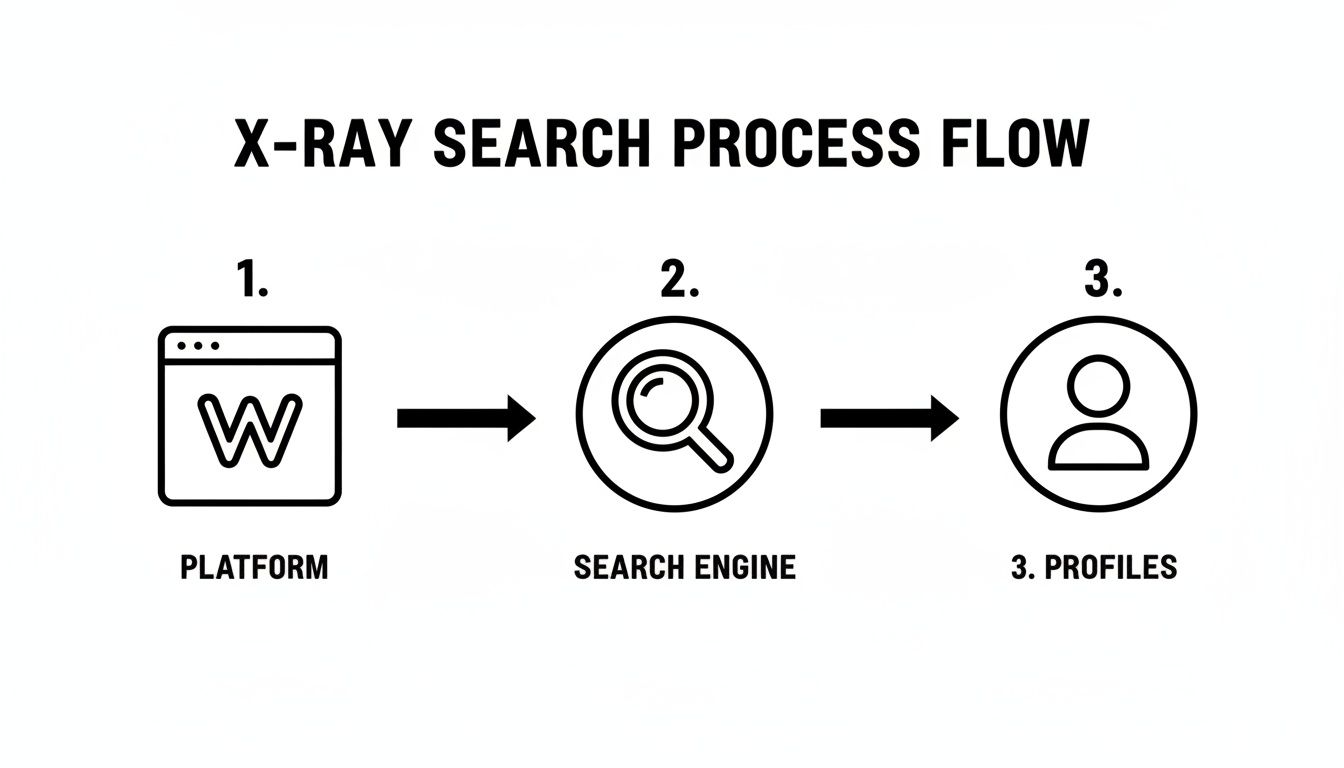
You’re not just searching on a platform anymore; you're searching inside it, bypassing its native search bar to find people directly.
Let’s start where most recruiters live: LinkedIn. Say you’re on the hunt for a "Senior Python Developer" in "Berlin" with some "e-commerce" experience under their belt.
Here's a string you can pop right into Google:
site:linkedin.com/in/ "Senior Python Developer" Berlin "e-commerce" -jobs -job
Let's break down what we're telling Google to do:
site:linkedin.com/in/: This is the most crucial part. It forces the search to look only at LinkedIn user profiles, which almost always have "/in/" in their URL."Senior Python Developer": Putting the job title in quotes tells Google to search for that exact phrase. No more random profiles with the word "senior" in one place and "developer" in another.Berlin "e-commerce": These are our non-negotiable keywords for location and industry.-jobs -job: The minus sign is our filter. It removes any results that mention "jobs" or "job," which is a great way to screen out all the job postings and get straight to the people.With one simple query, you've turned a generic search engine into a specialized sourcing machine. You're not just scrolling anymore; you're giving targeted commands to a massive database.
The real magic of X-raying is that it’s not just a LinkedIn trick. The same logic applies whether you're digging through GitHub, Stack Overflow, or any other site with public profiles. If you’re looking for more inspiration, you can unlock powerful results with these Boolean search strings examples.
Let's try another one. Suppose we need a "React" developer on GitHub, ideally someone who is actively looking. GitHub is a goldmine for tech talent, and you can often find direct links to portfolios or resumes.
Try this string:
site:github.com "React" "San Francisco" (resume OR cv OR portfolio)
This query homes in on GitHub, looks for profiles mentioning both "React" and "San Francisco," and then uses the OR operator to find anyone who also includes the word "resume," "cv," or "portfolio" on their page.
That last part is a classic sourcer's trick. It’s a fantastic way to surface candidates who have literally uploaded a document signaling that they’re open to new roles. You'll be amazed how many publicly available resumes you can find that other recruiters completely miss.

Crafting the perfect Boolean string feels like a superpower, doesn't it? But while a manual X-ray search is an indispensable skill, relying on it alone means you're operating with some serious blind spots.
These aren't just minor quirks. They're fundamental flaws that can cause you to miss out on incredible talent, and it all starts with one jarring issue: inconsistency.
The results you get from a Google X-ray search are anything but static. You’re completely at the mercy of Google's ever-changing indexing algorithm. The same query that surfaced a rockstar candidate yesterday might turn up nothing today, simply because Google decided to shuffle its rankings. This makes it a frustratingly unreliable foundation for any consistent sourcing strategy.
Beyond the random vanishing act of profiles, the bigger problem is the sheer volume of talent you’re simply not seeing. A manual X-ray search only scrapes the surface of what’s publicly available, which is often a tiny fraction of the data living inside a platform’s own ecosystem.
Platforms like LinkedIn are smart. They intentionally limit how much information their public-facing profiles show to search engines. This creates a massive information gap for sourcers.
Just how big is that gap? Research comparing sourcing methods tells a compelling story. A focused X-ray search on LinkedIn for specialized skills in New York City found 22 to 24 unique profiles. But running the exact same search inside LinkedIn Recruiter yielded 48 results.
That's a 100% increase. You can dig into the specifics of these disparities in search effectiveness on Boolean Black Belt. The takeaway is clear: you might only be seeing half the picture.
Relying solely on a manual X-ray search is like trying to map an entire country using only its public highways. You see the main routes, but you miss all the valuable towns, communities, and hidden gems just off the main road.
This data gap isn't an accident; it's by design. Social and professional platforms want you using their native tools (and paying for them), not finding backdoors through Google.
To give you a clearer picture, here’s a quick comparison of what you get with each approach.
| Feature | X-Ray Search (via Google) | Native Platform Search (e.g., LinkedIn Recruiter) |
|---|---|---|
| Result Volume | Limited to publicly indexed pages, often missing a significant number of profiles. | Accesses the entire user database, including those with limited public visibility. |
| Data Depth | Only scrapes surface-level, public information (name, title, location). | Provides access to complete profiles, including "About" sections, full experience, skills, and endorsements. |
| Reliability | Results can fluctuate daily based on Google's algorithm. Inconsistent. | Stable and repeatable search results directly from the platform's database. |
| Filtering | Limited to keywords and basic operators. | Advanced, platform-specific filters (years of experience, company size, etc.). |
The limitations of X-ray searching boil down to a couple of key factors:
These factors mean that even your most expertly crafted query is working with an incomplete dataset. To avoid falling into this trap, it’s worth reviewing the most common sourcing mistakes that slow down your process.
Ultimately, an X-ray search is a fantastic tool to have in your arsenal, but it should never be your entire toolkit.
If you've been in recruiting for a while, you know the feeling. A perfectly constructed X-ray search used to be like a secret handshake, opening doors to hidden talent pools that your competitors couldn't find. It was our go-to move for unearthing passive candidates.
But let's be honest—those once-reliable techniques are starting to fail us.
This isn’t just a small change or a temporary glitch. We're witnessing a deliberate shift in how professional platforms handle their data. The open web that made X-ray searching so powerful is slowly but surely being replaced by walled gardens.
Platforms like LinkedIn have been making a very calculated push to limit what search engines like Google can crawl and index on their public profiles. The goal is simple: if they make sourcing outside their platform harder, they can pull more recruiters back into their expensive, paid ecosystem.
And it's working. Since early 2024, we’ve seen a dramatic reduction in the amount of information visible on public profiles. What you can find today with a Google site search is a pale shadow of what was available just a short time ago.
So, what’s actually gone?
We're talking about an estimated 70-80% reduction in the kind of indexable data sourcers have built their workflows around. The experts at PCR Staffing have written about the death of X-ray search for recruiters, and their observations match what many of us are seeing on the ground.
Simply put, your best X-ray searches are hitting brick walls. You're looking for keywords that are no longer public, making it incredibly difficult to find that perfect passive candidate with the same level of precision.
This data lockdown means your go-to Boolean strings are now running on fumes. You might be searching for a "Senior Golang Engineer" with "fintech experience," but if those critical keywords are locked away in an "About" section that Google can no longer see, that perfect profile is completely invisible to you.
The old methods are breaking because the public data they scraped is disappearing. For sourcing professionals, this isn't just an inconvenience; it requires a fundamental rethink of our entire strategy. Relying solely on manual X-ray searches is no longer a viable way to build a consistent, high-quality pipeline.
As the game gets more complex, it’s clear we need to adapt. It's crucial to explore how new approaches can fill the gap, which is why it's worth understanding how AI is transforming candidate sourcing from Boolean to neural search. The talent pool you can access with old tools is shrinking by the day.
If you've been running manual searches lately, you know they just aren't cutting it anymore. The old playbook is broken. The limitations of a manual x ray search are becoming painfully obvious—from wildly inconsistent results to profiles that have all but disappeared behind privacy walls. It's time for a smarter approach, and that's where AI-powered sourcing co-pilots like Tapflow come in.
Think of it this way: you can completely skip the tedious process of building, testing, and debugging complex Boolean strings. Instead of wrestling with operators and parentheses, you just feed the platform a job description. The AI instantly generates a search-ready profile for you.
This simple shift changes your job entirely. You’re no longer a query builder; you’re a strategist. The tech handles the grunt work, launching a deep, multi-platform search that uncovers talent you would've otherwise missed.
Here’s the thing—AI-driven platforms don't just run a faster x ray search. They completely reinvent it. By tapping into multiple data sources at once, they can stitch together a far more detailed candidate profile than you'd ever find on a single public page. This is how you get around the data lockdown problem, giving you a complete view of someone's real skills and experience.
To build these rich profiles, these tools often go beyond basic search, using advanced techniques like social media web scraping. The outcome is a talent pool that’s broader, more accurate, and frankly, more reliable. You're no longer at the mercy of whatever Google’s algorithm feels like showing you that day.
The real advantage of an AI co-pilot isn't just speed; it's depth. It builds a richer, more complete candidate profile by pulling data from multiple sources, giving you insights that a simple Google search could never provide.
This new way of working transforms the sourcing workflow for the better. Forget getting a raw list of a hundred links to click through. AI platforms deliver a ranked and scored list of candidates based on how well they actually fit your ideal profile.
This intelligent filtering means you can finally spend your time where it counts: engaging with top-tier talent, not just trying to find them. The benefits are immediate and obvious:
This is how the best recruiting agencies are staying ahead. They haven't abandoned the core principles of sourcing; they've just upgraded their toolkit to do it faster, smarter, and at a much bigger scale. To keep up, you have to understand the tools and strategies in the modern recruiter's AI toolkit.
As you start using X-ray searches in your daily sourcing, you'll probably run into a few questions. That's completely normal. Let's tackle some of the most common ones I hear from other recruiters to get you sourcing with confidence.
You might be wondering if this is even necessary with powerful tools like LinkedIn Recruiter at our fingertips. The answer is a resounding yes. Think of it this way: paid platforms are walled gardens. An X-ray search lets you explore the entire public internet.
You'll uncover profiles on niche professional sites, personal portfolios, and industry directories—places where incredible talent often exists completely off the radar of mainstream tools. It’s how you find the people who aren't necessarily looking.
This is a big one, and it's smart to ask. The good news is that X-ray searching only accesses publicly available information. You aren't hacking or breaking through any security walls.
That said, you still need to be mindful of data privacy laws like GDPR.
The golden rule here is simple: operate with transparency and respect. Use the information a candidate has clearly made public for professional reasons, and make sure your outreach is always relevant and considerate of their privacy.
It can be frustrating when a search string that worked yesterday gives you different results today. This is one of the main limitations of doing this manually, and it usually happens for a few reasons:
You can learn the basic operators like site: and "" and start finding relevant profiles in less than an hour. The fundamentals are surprisingly quick to pick up and put to use right away.
True mastery, though, comes from practice. Over time, you’ll get a feel for the unique structure of different websites and learn which keyword combos work best for your roles. If you want to take your sourcing to the next level, you can even explore advanced AI hiring strategies that are reshaping how we find and assess talent. Think of it less as a one-and-done task and more as a skill you constantly sharpen.
Stop wrestling with manual searches and inconsistent results. Tapflow is the AI co-pilot that automates your sourcing, finds more qualified candidates, and helps you hire faster. Discover how Tapflow can transform your agency’s workflow.


.svg)