

Let's get one thing straight: a recruitment strategy isn't just a fancy term for posting jobs and hoping for the best. It's your agency's game plan for finding, attracting, and hiring the exact people your clients need to win.
Think of it as the difference between just filling an empty seat and deliberately building a championship team.

It’s easy to confuse the actions of recruiting—sourcing, screening, interviewing—with having a real strategy. But those are just the tactics. They're the individual plays you run.
A true recruitment strategy is the playbook. It's the overarching vision that dictates why you're running those plays, ensuring every hire you make pushes your client's business forward.
Let's use an analogy. The individual recruiting tasks are like the bricks, wood, and nails for building a house. Your recruitment strategy is the architectural blueprint. Without that blueprint, you’re just piling up materials and hoping it somehow turns into a stable, valuable home. With it, every piece has a purpose.
Too many agencies get stuck in a "firefighting" mode. A client has an urgent opening, and the scramble begins. This is reactive hiring—a scattergun approach that almost always leads to rushed decisions, bad fits, and that constant feeling of being one step behind.
It's a tough spot to be in, especially when 75% of organizations already report struggling to fill their full-time roles. A lack of planning just makes a hard job even harder.
A strategic approach flips the script entirely. You start building talent pipelines before you need them. You nurture relationships with great candidates who aren't even looking yet. You build a brand that makes top talent want to take your call.
Suddenly, hiring isn't a frantic emergency. It's a well-oiled machine that fuels growth.
The table below breaks down just how different these two mindsets are.
As you can see, the proactive, strategic approach is designed for consistency and quality, turning recruitment from a cost center into a value driver.
A solid recruitment strategy doesn't just happen. It's built on four key pillars that work together. Nail these, and you'll have a hiring engine that consistently delivers.
For a deeper look at different tactics, this guide on 10 powerful hiring and recruiting strategies offers some great ideas.
And if you're laser-focused on the tech world, we’ve also put together a guide with powerful strategies to attract top tech talent.

Running a recruitment agency without a documented hiring strategy is like trying to build a house without blueprints. You might get some walls up, but the result is going to be messy, expensive, and unstable. A lot of agencies fall into this trap, treating every new role as a frantic, one-off fire drill instead of a core business process.
When you put a formal strategy down on paper, you transform that chaos into a repeatable, scalable machine. It’s the difference between hoping for a great hire and engineering one. This document becomes your agency’s playbook, getting every recruiter, account manager, and stakeholder on the same page about goals, methods, and what a win actually looks like.
This kind of alignment pays off immediately. When everyone knows the plan, decisions get made faster, communication is crisper, and the entire hiring cycle just flows better.
Let's be blunt: hiring is expensive, and mistakes are even more so. A single bad hire can cost a company a fortune—the common estimate is a staggering 30% of that employee’s first-year salary. That’s not just lost wages; it’s wasted training hours, drained productivity, and a serious blow to team morale.
A solid, documented strategy is your best line of defense. It forces a consistent, quality-first approach that measures candidates against a clear set of criteria, not just a hiring manager’s gut feeling. This discipline dramatically boosts your odds of making a placement that sticks.
A well-defined recruitment strategy isn’t a cost center; it’s a powerful risk management tool. By standardizing your approach, you minimize costly hiring mistakes and maximize the return on your most important investment—people.
On top of that, a more efficient process naturally shortens your time-to-hire. Faster placements mean happy clients, and it frees up your team to tackle the next req, driving up your agency's overall throughput and revenue.
In a market this tight, you have to remember that candidates are interviewing you just as much as you're interviewing them. In fact, around 66% of candidates say a positive hiring experience was a key factor in their decision to accept a job offer. A messy, disorganized process is a giant red flag for top-tier talent.
A documented strategy makes sure every single candidate gets the same professional, respectful, and transparent treatment.
Getting this right doesn't just help you close the best candidates; it builds your agency's brand. Even people who don't get the job walk away with a good impression, and you never know when that will turn into a referral.
Maybe the biggest win from having a formal strategy is the shift it creates—from reactive scrambling to proactive recruiting. Instead of starting from scratch every time a client sends over a new job description, you're constantly building and nurturing a pipeline of qualified, engaged talent.
Your strategy should define how you'll source and connect with potential candidates year-round, even when there isn't an immediate opening. This kind of foresight future-proofs your agency and gives you a massive head start when new roles land on your desk. Looking ahead, it's obvious that recruitment agencies that automate will outperform the competition, and a rock-solid strategy is the essential foundation for making that automation work.
A great recruitment strategy isn't just one thing—it's a whole system of moving parts working in harmony. Think of it like a high-performance engine. Every single component has to be perfectly designed and tuned, or the whole machine sputters and stalls. If you neglect even one piece, you'll feel it in your results.
To build a hiring engine that consistently brings in top-tier talent, you need to nail six critical components. These are the building blocks that take you from a reactive, fire-fighting hiring process to a proactive talent acquisition powerhouse.
The best recruitment strategies are woven directly into the fabric of the business. Hiring can't happen in a vacuum. Every single role you fill has to directly push a bigger company goal forward, whether that’s launching a new product, breaking into a new market, or just making things run smoother.
It all starts by asking the right questions: What's the company trying to achieve this year? What critical skills are we missing that are holding us back? This simple shift changes the conversation from "We need to fill this seat" to "We need someone who can help us achieve X."
When you tie every hire to a tangible business outcome, you stop being just a service provider and become a true strategic partner. This alignment makes sure you’re not just finding people, but finding the right people who will actually move the needle.
You can't find what you haven't defined. This is where a candidate persona comes in. It’s a detailed profile of your ideal hire, going way beyond just skills and experience. It gets into their motivations, career ambitions, and even how they prefer to be contacted.
Think about the difference between searching for "a software developer" versus searching for "a mid-level Python developer who thrives in fast-paced, collaborative teams and gets a kick out of solving tricky data problems." One is a shot in the dark; the other is a laser-focused search.
A sharp, well-defined persona becomes your roadmap for everything that follows:
This level of detail makes your sourcing efforts exponentially more effective. You end up spending your time talking to people who are a genuine fit, not just a keyword match.
Once you know exactly who you're looking for, the next step is figuring out where to find them. Just posting on a single job board and hoping for the best is a surefire way to get a shallow, uninspired talent pool. A modern strategy uses a multi-channel approach, mixing reliable old standbys with newer, more creative avenues.
In today's cutthroat talent market, social media sourcing is no longer optional. A massive 60% of organizations worldwide plan to make it their top approach in 2025. This shows just how much platforms like LinkedIn, Twitter, and even niche communities have evolved from social networks into serious sourcing battlegrounds.
Your employer brand is what people say about working at your client's company when no one from the company is around. It’s the real story—a mix of reputation, culture, and the promises made to employees. When top candidates have their pick of opportunities, a strong employer brand is your most powerful magnet.
It’s built by being consistent at every single touchpoint. It’s in the tone of your job descriptions, the transparency of your interview process, and the way you treat every candidate. Things like sharing real employee stories, being upfront about company values, and maintaining an active social media presence all work together to build a brand that pulls the right talent in.
A strong employer brand acts like a magnet, pulling in the right candidates while repelling the wrong ones. It pre-sells potential hires on the company culture before they even speak to a recruiter.
The candidate journey is the entire experience someone has with you and your client, from the moment they first hear about the role to the day they get an offer. Nothing turns off great talent faster than a clunky, impersonal, or painfully slow process. A positive journey means mapping out every stage and optimizing it for clarity, respect, and momentum.
This is where a real focus on candidate relationship management pays off big time. Building genuine rapport, giving timely feedback (even when it’s a “no”), and treating every single applicant like a professional builds incredible goodwill. Our guide on improving your candidate relationship management has some great tips for making this a core strength.
At the end of the day, a strategy without a scoreboard is just a collection of good intentions. You need to define Key Performance Indicators (KPIs) to actually measure what’s working and what isn’t. These metrics give you the hard data you need to stop guessing and start making smart adjustments.
Beyond just having a plan, agencies need to stay on top of broader talent acquisition best practices to keep their edge. Your KPIs will tell you exactly how well you're doing it.
Knowing the what and why of a recruitment strategy is one thing. Actually building one from the ground up that works? That’s where the real magic happens. This is where theory gets its hands dirty. A solid roadmap takes those big, ambitious goals and breaks them down into clear, manageable steps your team can actually follow.
For small and mid-sized agencies, this isn’t about drafting a 100-page manifesto. It’s about creating a lean, mean, repeatable framework that gets you consistent wins. Let's walk through how to do it in six practical steps.
Before you can build something better, you have to get painfully honest about what you’re doing right now. Start by taking a hard look at your current recruitment efforts. Don't be afraid to look at the messy parts—that's where the best lessons are hiding.
Pull the data from the last six to twelve months. What’s your average time-to-fill? Where are your best candidates really coming from (source of hire)? And what’s your offer acceptance rate? The numbers don’t lie; they’ll tell you a story about what’s working and, more importantly, what’s burning time and money.
Recruiting can't live on an island. It has to be the engine driving your client's growth. The next step is to sit down with key stakeholders and translate their big-picture business goals into specific talent needs.
You have to ask the right questions to build this bridge:
This alignment is everything. It shifts your role from a simple service provider to a genuine strategic partner, ensuring you’re not just filling seats but finding the exact people who will move the needle.
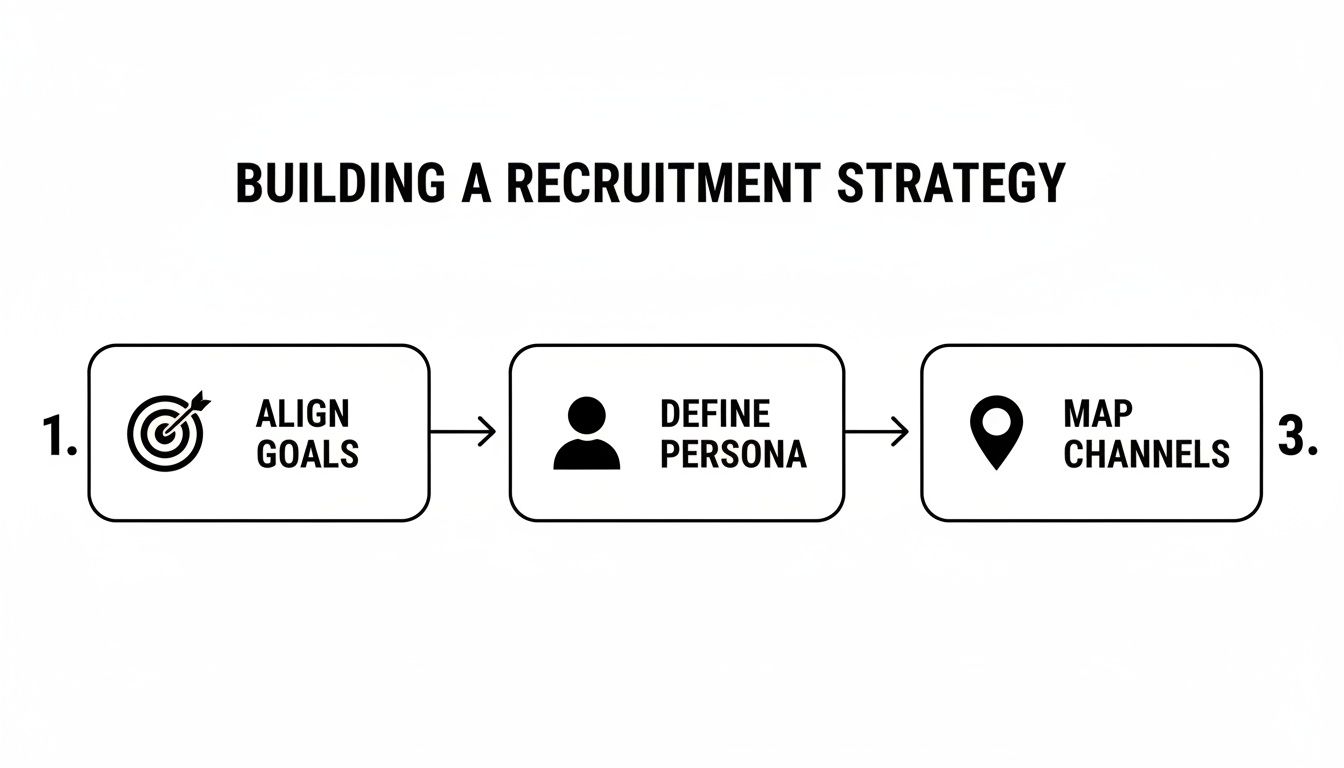
This visual really nails it: a winning strategy always starts with clear goals before you ever start thinking about the who.
You’ll never find top-tier talent if you don’t have a crystal-clear picture of who you're looking for. A candidate persona is your semi-fictional, deeply detailed profile of the ideal hire. It goes way beyond a boring list of skills on a job description.
A killer persona gets into the nitty-gritty:
This persona becomes your North Star for all sourcing and outreach. It makes sure every action you take is laser-focused and effective.
With your persona locked in, you can now build a sourcing plan to meet these candidates where they live. Your playbook should map out a multi-channel attack, blending different tactics to keep your pipeline full of quality talent.
Don't just rely on one channel. Your playbook needs to detail exactly how you'll approach everything from job boards and your own ATS to proactive, targeted outreach on platforms like LinkedIn. The goal is to create a repeatable process for how you find, engage, and nurture candidates across every channel you use.
For smaller agencies, manual sourcing is a productivity killer. It’s a massive bottleneck. This is where the right tech stops being a "nice-to-have" and becomes a game-changer. AI-powered tools aren't just for the big guys anymore; they are accessible, powerful solutions that level the playing field.
Today's AI co-pilots can automate the most grueling parts of recruiting, letting a small team punch way above its weight. It's not just about being faster—it's about surviving and thriving.
Take a platform like Tapflow, for example. You can literally paste a job description, and it will instantly generate a detailed candidate persona for you. Then, its AI gets to work, automatically scouring places like LinkedIn to find and score candidates who are a perfect match—no more wrestling with complex Boolean strings. It allows you and your team to focus on what humans do best: building relationships.
Last but not least, your strategy can't be a "set it and forget it" document. The talent market is always shifting, and your approach has to be just as nimble. You need to build in a regular schedule for checking in on your strategy’s performance.
Set up quarterly reviews to dive into your KPIs. Are you hitting your time-to-hire goals? Is the quality of hire where it needs to be? Which sourcing channels are giving you the best bang for your buck? Use that data to make smart adjustments—double down on what's working and ruthlessly cut what isn't. This constant feedback loop is what separates a good strategy from a truly great one.

Let's be honest: manual recruiting is a grind. We've all been there—hours lost wrestling with complex Boolean searches, sifting through hundreds of profiles that are almost right, and then trying to personalize outreach emails one by one. It’s a huge drain on time and energy, especially for smaller agencies trying to keep up with the big players.
This is where smart technology, particularly accessible AI tools, completely changes the game.
It’s not about replacing recruiters with robots. Think of it as giving them a co-pilot—an assistant that handles the repetitive, mind-numbing tasks so your team can focus on what actually matters: building relationships, understanding what clients really need, and closing top-tier candidates.
And this kind of tech isn't just for mega-corporations anymore. It’s a genuine advantage that levels the playing field, letting smaller, agile agencies punch well above their weight.
The old way of sourcing often feels like blindly searching for a needle in a digital haystack. You craft the perfect search string, hit enter, and just hope the right people pop up. AI flips that entire process on its head. Instead of just matching keywords, it's about intelligent discovery.
Tools like Tapflow can take a simple job description and instantly generate a detailed ideal candidate persona. This persona then acts as the AI's guide, empowering it to scan platforms like LinkedIn not just for keywords, but for context, skills, and career history.
By automating the grunt work of finding and scoring candidates, AI doesn't just make sourcing faster—it makes it smarter. This frees up recruiters to spend less time digging and more time actually engaging with A-list talent.
In today's market, personalization is everything. Generic, copy-paste messages are a one-way ticket to the trash folder. But who has time to personalize outreach for hundreds of candidates a week?
This is where an AI co-pilot becomes your secret weapon. It can analyze a candidate's profile and help you draft tailored, relevant outreach emails at scale. By referencing specific projects, shared connections, or recent career moves, it helps you create messages that feel genuine and stand out in a crowded inbox. This alone can give your response and conversion rates a massive boost.
Our guide on how to use AI in recruiting dives much deeper into these practical applications.
One of the most powerful things this technology does is break down geographical barriers. A game-changing strategy that’s gaining huge traction is global talent sourcing—in fact, over 50% of companies plan to increase their international hires by 2026, according to Remote's 2025 Global Workforce Report.
With an AI co-pilot, your agency can paste a job spec, generate a persona, and source scored candidates from LinkedIn across the globe, all without getting bogged down in complex compliance issues. This approach can slash hiring costs by 30-40% while opening up incredibly diverse talent pools for your clients.
Even with the best roadmap, you're going to have questions once the rubber meets the road. A recruitment strategy isn't a static file you create once and admire; it's a living, breathing document. So, it's completely normal to wonder how to keep it sharp and effective.
Think of this section as your final pre-flight check. We'll tackle some of the most common questions that pop up, giving you the clarity and confidence to put your new hiring approach into action.
Your strategy should never be a "set it and forget it" kind of deal. The talent market shifts, your clients’ needs evolve, and your approach has to keep up.
As a general rule, plan for a major review annually. This is your chance to zoom out and make sure your strategy still aligns with your big-picture business goals and what's happening in the market.
But don't wait a full year if things feel off. You should be doing quarterly check-ins on your key metrics. If you see your time-to-hire creeping up or your offer acceptance rate taking a nosedive, that’s a red flag. Those are clear signals that a part of your strategy needs a tune-up now, not later.
It’s easy to get these two mixed up, but they play very different roles. I like to think of it like planning a cross-country road trip.
Your strategy is the destination and the why. It’s the big idea: "We're driving to California to open a new office." It's your high-level, long-term vision. Your plan is the turn-by-turn navigation—the exact highways to take, the gas stops, and the hotels you'll stay at along the way.
A recruitment strategy is your overarching vision for how you'll attract the right talent to hit your business goals. A recruitment plan is the nitty-gritty tactical document that outlines the specific actions, timelines, and resources you need to fill a specific role or build out a team. You absolutely need both to get where you're going.
One hundred percent, yes. A great strategy is about being smart and resourceful, not about having the deepest pockets. For smaller agencies, it all comes down to focusing on high-impact, low-cost moves that give you the most bang for your buck.
Here are a few budget-friendly ideas to build your strategy around:
This is also where smart tech comes in. Affordable AI tools can give a small team the horsepower of a much larger one by automating the grunt work of sourcing and outreach, freeing you up to focus on building relationships.
Ready to give your small agency the power of a much larger team? See how Tapflow uses AI to automate sourcing, score candidates, and supercharge your outreach. Start hiring smarter, not harder, with Tapflow today.


.svg)