

Think of the last time you had an urgent role to fill. Did you start from scratch, posting a job ad and praying the right person would apply? That’s the old way—a reactive, frantic scramble that feels a lot like fishing. You cast a line and just hope for a bite.
What if, instead, you had a garden? A place where you’ve already planted seeds (potential candidates) and have been nurturing them all along. When a role opens up, you don't have to go fishing; you just walk into your garden and pick the best talent, already warmed up and ready to go.
That’s the essence of Candidate Relationship Management (CRM). It’s a fundamental shift from a transactional "fill-the-job" mindset to a proactive, relationship-building strategy.

At its core, Candidate Relationship Management is about cultivating a community of potential hires before you ever have a job opening for them. It’s the art of staying connected with promising individuals—from past applicants and silver medalists to passive talent you’ve sourced over time.
Instead of a dusty, forgotten database, your talent pool becomes a living ecosystem. You consistently engage these contacts with relevant content, industry insights, and personalized check-ins, keeping your agency top-of-mind.
This strategic shift is the core of modern recruiting. It’s about transforming your talent pool from a static list of names into a dynamic community of potential hires who feel a genuine connection to your agency and its clients.
Let's contrast the old way with the new. The traditional recruiting model has always been purely transactional. A job opens, you find a candidate, you fill the job, and the interaction ends. This approach leaves so much value on the table, especially with those fantastic "silver medalist" candidates who were a great fit but just missed out on one specific role.
A CRM-driven strategy completely flips this script. It’s all about playing the long game.
This new approach helps you:
Take a look at how these two approaches stack up side-by-side.
This table breaks down the key differences between the reactive, old-school method and the proactive, relationship-focused approach that a CRM enables.
The difference is stark. The CRM-driven model isn't just a minor tweak; it's a complete reimagining of how recruiting gets done.
The dividends from this shift are substantial. Agencies that fully integrate a CRM into their workflow have seen recruiter productivity jump by up to 50%. Even better, they report filling roles 30% faster on average compared to teams stuck in the old ways. This isn't magic; it's the direct result of automating outreach and having clean data, which frees up recruiters to do what they do best: build meaningful connections.
A great candidate relationship management strategy isn't something you can just switch on. It's something you build, piece by piece, on a solid foundation of intentional actions. Think of it like building a house. You need strong support pillars to hold everything up, ensuring your agency can grow without the whole thing collapsing.
Without these pillars, you’re just sitting on a disorganized pile of contacts, not a powerful talent engine. They provide the framework for turning a passive database into a vibrant, engaged community of people ready for their next big move.
First things first: you have to get your talent organized. Just dumping every resume you find into one giant list is like throwing all your important documents into a single, massive drawer. Sure, it's all in there, but good luck finding what you need when a client calls. Talent pooling is the art of creating specific, curated groups of candidates.
From there, segmentation is where the real magic happens. This is where you slice and dice your talent pools based on what matters. You can group candidates by almost anything:
Suddenly, your generic list becomes a strategic weapon. When a hot new role for a Python developer in Austin lands on your desk, you know exactly which pool to dive into first. The time and effort you save is enormous.
Okay, so your talent is neatly organized. Now what? The next pillar is all about building and maintaining those relationships through steady, thoughtful communication. This is what we call candidate nurturing. It's the ongoing process of keeping your talent pools warm and engaged, even when you don't have a job for them right this second.
And let's be clear: this isn't about spamming people with generic job alerts. Real nurturing provides genuine value. Instead of just blasting out another job description, you could share a fascinating article about new trends in their field or a practical guide on acing a virtual interview.
A great nurturing strategy makes candidates feel like they're part of a professional community, not just another name on a list. It builds trust and keeps your agency top-of-mind, so when the perfect role does appear, you’re the first person they think of.
Effective communication is the engine that drives this entire pillar. Keeping people in the loop on their application status and being transparent about timelines is how you build trust and improve the candidate experience.
With thousands of potential candidates in your pools, how do you decide where to focus your attention? That’s where the third pillar, candidate scoring and prioritization, comes in. This is a data-driven way to automatically surface the most promising people in your pipeline.
Think of it as a quality filter working for you 24/7. Your CRM can assign points to candidates based on what they do or who they are:
This system lets your team see at a glance who is most engaged and qualified. It means you spend your time having meaningful conversations with high-potential people instead of digging through profiles that aren't a fit. For more on how to craft those messages, take a look at our guide on the perfect recruiting email template.
The final pillar ties everything together: analytics and reporting. Any strategy is only as good as the results you can measure. This pillar is all about tracking key metrics to figure out what’s working, what’s not, and where you can get better.
Without data, you're just guessing. A solid CRM gives you real insights into performance. You can see which email subject lines get the most opens, which talent pools generate the most placements, and how your engagement rates are trending month-over-month. This feedback loop is absolutely critical for fine-tuning your strategy and proving the ROI of your hard work to both clients and your own team.
Knowing the theory behind candidate relationship management is one thing. Actually putting it to work is another challenge entirely.
A solid CRM strategy isn't just a single action; it’s a living, breathing workflow. It’s the journey that takes a complete stranger, turns them into an engaged member of your talent community, and ultimately, helps them land their next great role. This process gives tangible shape to abstract ideas like "nurturing," breaking it down into clear, repeatable steps.
Mapping out this path from first contact to final placement clears up the whole process. It acts as a practical blueprint that any recruitment agency can pick up and adapt to start building a genuinely powerful talent pipeline. Let’s walk through the essential stages.
It all starts with sourcing. The goal here is to cast a wide but precise net to bring in both active job seekers and those passive candidates who aren't even looking yet. This means you have to go beyond just sifting through job board applications and start proactively hunting for talent on platforms like LinkedIn, at industry events, and through referrals.
Once you’ve found promising people, they go into your talent pool. This isn't just a digital filing cabinet; think of it as the core asset of your entire CRM. The next move is critical: immediately segment these candidates into specific pools, like "Senior Software Engineers" or "Bay Area Marketing Leaders." This groundwork is what makes personalized communication possible down the road.
With your talent pools organized, it’s time to start nurturing. This is the real heart of candidate relationship management—where you build trust and make sure your agency stays top-of-mind. The secret is to provide real value, not just blast people with job openings.
Good nurturing is a smart blend of automated and personal touchpoints:
The aim is to create a consistent, positive presence. So when a role finally does open up, you're not a stranger reaching out cold; you're simply continuing a conversation you’ve already started. For a deeper dive, learn more about how AI is changing the way we source candidates by creating dynamic talent pools.
One of the most common points of confusion in this whole workflow is the difference between a CRM and an Applicant Tracking System (ATS). They do different jobs, but they work best together.
Think of your CRM as a marketing tool for your entire universe of talent. It's built to manage long-term relationships with a huge number of potential candidates (the "many"). Your ATS, on the other hand, is a workflow tool for managing active applicants in a specific hiring process (the "few").
A candidate might live in your CRM for years, getting occasional updates, before they ever become an active applicant in your ATS. The CRM builds the pipeline; the ATS manages the people currently flowing through it for a specific job. To make your CRM workflow even smoother, you can draw inspiration from various business process automation examples to handle the repetitive stuff.
The diagram below breaks down the core stages of a typical CRM lifecycle, from pooling candidates to analyzing your results.

This visual shows that a great CRM isn't a one-and-done task. It's a continuous cycle of building, nurturing, and evaluating your talent pools to make sure you always have quality candidates ready to go.
Let's be realistic: manually personalizing outreach for hundreds or thousands of candidates is impossible. This is where modern AI-driven tools have become a game-changer. AI can put your CRM workflow into overdrive by automating personalization at a massive scale, making sure every single message feels relevant and unique.
Platforms like Tapflow can analyze a candidate's profile and a job description to generate a hyper-personalized outreach message in seconds. This gives recruiters back their time while still maintaining a crucial human touch. You get dramatically higher engagement rates and stronger relationships, freeing up your team to focus on what they do best: having strategic conversations and closing hires. This blend of human strategy and AI execution is what defines the future of effective recruiting.

If you aren't measuring your strategy, you're just guessing. To really prove that your candidate relationship management efforts are paying off, you have to look past gut feelings and focus on tangible results. The only way to know what’s working, what isn't, and where to double down is by tracking the right key performance indicators (KPIs).
These numbers aren't just for reports; they're the vital signs of your recruiting engine. They give you the hard data needed to show a clear return on investment (ROI) and justify the time and resources you're pouring into building a strong talent community. This focus on data is exactly why the CRM software market is booming, expected to grow from $1.4 billion in 2024 to $1.8 billion by 2029. You can explore more on CRM market trends to see why this tech is becoming a non-negotiable for modern agencies.
Tracking CRM performance can feel overwhelming, so we've broken down the essential metrics into a simple table.
Ultimately, these metrics tell a story. They reveal how effectively you're turning passive contacts into engaged candidates and, eventually, successful placements. Let’s take a closer look at what each of these KPIs really means for your agency.
The most basic sign of a healthy CRM is the state of your talent pool. It’s not just about the pool getting bigger; it's about it getting better. Are you consistently adding qualified people to the talent pipelines that matter most to your clients?
Look at the ratio of qualified-to-unqualified candidates you add each month. A healthy system shows a steady stream of people who actually fit the roles you specialize in. This is the bedrock of proactive recruiting.
A silent talent pool is a dead one. Your Engagement Rate is the KPI that tells you if your nurturing efforts are actually connecting with people. It measures how candidates are interacting with your emails, texts, and other communications.
Pay close attention to these actions:
If these numbers are low, it's a huge red flag that your content or cadence is off. But when engagement is high, you know you have a warm audience ready for the next opportunity.
Don’t confuse activity with progress. A large talent pool with zero engagement is just a list. True success in candidate relationship management is measured by the quality of the conversations you're having, not just the number of contacts you've collected.
This is where your CRM work hits the bottom line. Time-to-fill is the total number of days a job stays open, while time-to-hire tracks the journey from when a candidate enters your pipeline to when they accept an offer. A well-oiled CRM should shrink both of these metrics dramatically.
When you have a pool of pre-vetted, engaged candidates, you can present a stellar shortlist almost instantly. You get to skip the painful, time-consuming sourcing and screening that plagues traditional reactive recruiting. A steady drop here is undeniable proof that building relationships ahead of time works.
Finally, you absolutely have to know where your placements are coming from. The Source of Hire metric is your golden ticket for proving the value of your talent community. It's simple: tag every candidate in your CRM with how they found you—whether it was your own proactive sourcing, a past application, or a referral.
When you fill a role, check that source tag. Over time, you should see a growing percentage of your hires coming directly from the talent pools you've been nurturing. This data proves that your CRM isn't just a side project; it's a core driver of your agency's success.
Bringing a Candidate Relationship Management strategy into your agency is a game-changer, but it's not a silver bullet. I’ve seen agencies invest in top-of-the-line software only to watch it fail because of how they used it. They fall into the same old traps, turning what should be a thriving talent community into a digital graveyard of forgotten contacts.
Let's break down these common pitfalls. Knowing what they are is half the battle. This isn't just about adopting a new tool; it's about committing to a smarter way of recruiting. The agencies that get this right are the ones that thrive, while others are left wondering why their expensive database isn't doing anything for them.
By far, the biggest mistake is treating the CRM like a dusty, digital filing cabinet. It's the classic "set it and forget it" approach, and it completely misses the entire point of having a CRM in the first place. A CRM is a living, breathing ecosystem. It needs constant care and attention to be worth anything.
When you see it as just a list of names, you stop nurturing people, your data gets stale, and the whole system becomes reactive instead of proactive. The goal was never just to store résumés—it was to build relationships.
Key Takeaway: Your CRM's value comes from continuous engagement, not just data storage. Actively nurture your talent pools with valuable content and personalized check-ins to keep the community alive and your pipeline warm.
To get around this, you have to commit to regular, value-driven communication. Send out relevant industry news, share career advice, or give company updates tailored to specific talent pools. That’s how you turn a passive list into an active, engaged network ready for your next big role.
Look, automation is one of the best parts of a CRM, but it's a slippery slope. Relying too heavily on generic, automated emails makes great candidates feel like just another name in a spreadsheet. Real candidate relationship management is built on genuine connection, and that always requires a human touch.
Personalization isn't just dropping a [First Name] tag into an email template. It’s about remembering a candidate's career goals, referencing a past conversation, or mentioning a specific skill they have. When you over-automate, you strip all that authenticity away and end up damaging the very relationships you’re trying to build.
A good rule of thumb is to automate the logistics but personalize the interaction.
This balanced approach gives you efficiency without sacrificing the personal connection that makes your agency memorable.
A CRM is only as good as the information inside it. Outdated emails, incorrect skill tags, and duplicate profiles can quickly turn your powerful tool into a cluttered, unreliable mess. Poor data hygiene makes it impossible to run targeted campaigns, and you simply can't trust what your system is telling you. A survey found that nearly half of all candidates have been ghosted, and messy data is often the silent culprit behind those communication breakdowns.
Just as bad is failing to connect your CRM with your other critical tools, especially your Applicant Tracking System (ATS). When your CRM and ATS are siloed, you create a clunky, disjointed experience for both your recruiters and your candidates. Recruiters waste hours manually copying data from one system to another, and candidates get confusing, mixed messages.
The fix? First, establish a clear process for how data gets entered and schedule regular clean-up audits. Second, make sure your CRM and ATS are properly integrated to create a single, seamless flow of information from sourcing all the way to placement. This gives you one single source of truth for your entire recruiting process.
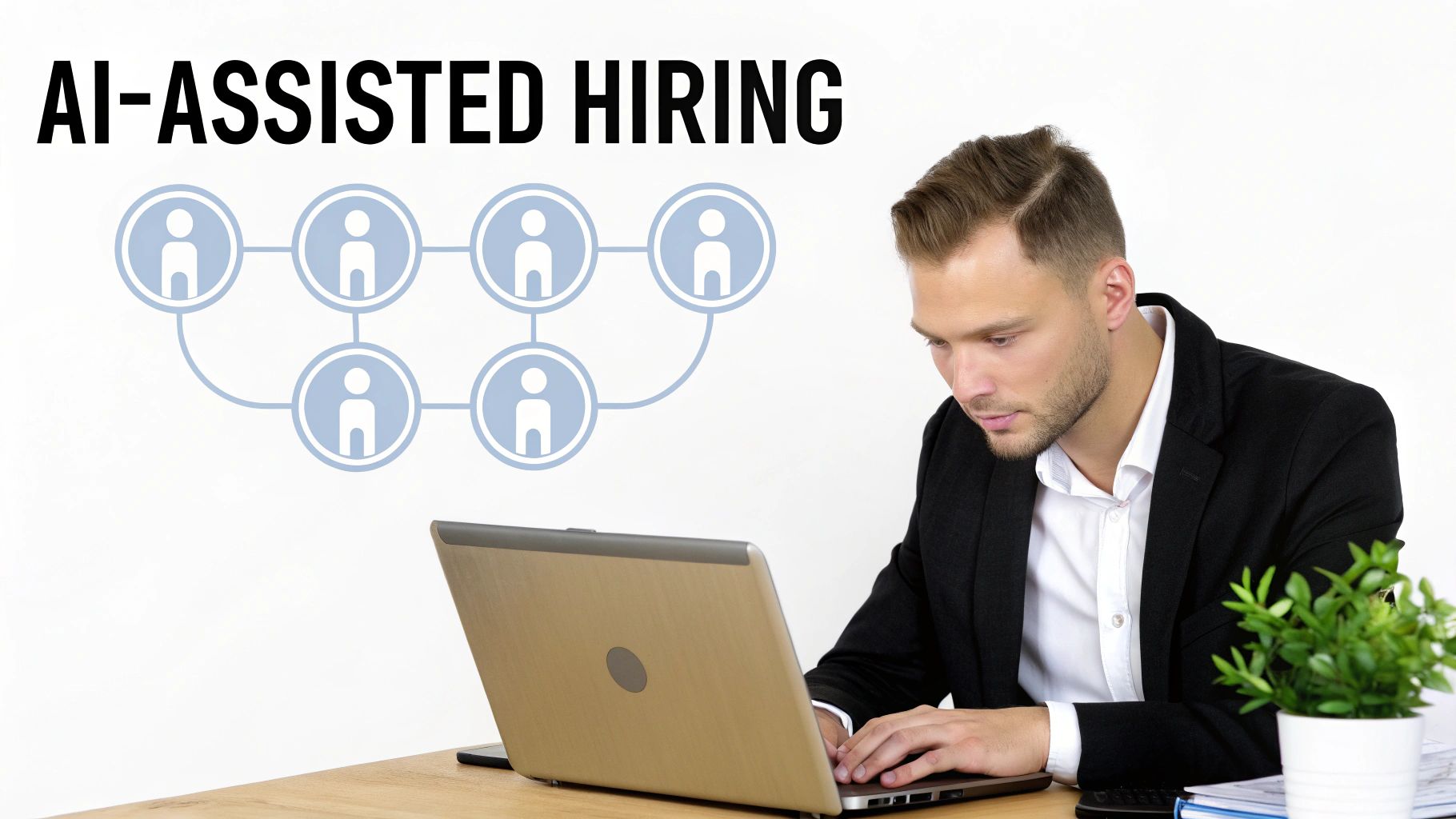
Let’s be honest: while a solid candidate relationship management strategy is a game-changer, it has always been a massive time sink. Juggling thousands of relationships and trying to keep them all warm with genuinely personal touchpoints? That’s a monumental task for any recruiter.
This is exactly where modern technology flips the script. It can turn a draining, manual process into a highly efficient, scalable engine for making more placements.
Think of artificial intelligence not as a replacement for recruiters, but as a co-pilot. AI tools are built to handle the repetitive, data-heavy work that bogs down your team, freeing them up to focus on what they do best: strategic advising, building rapport, and closing top-tier candidates. This blend of human expertise and machine efficiency is redefining what’s possible in recruiting.
The most immediate impact AI has is on talent sourcing. Instead of spending hours wrestling with Boolean strings and manually digging through profiles, platforms like Tapflow use AI to automatically find and add high-quality, passive candidates to your talent pools. The technology scans huge networks to pinpoint ideal fits based on your job descriptions, saving your team from hours of tedious searching. You can see similar principles at work in the broader field of AI-powered lead generation.
But where AI really shines is in elevating your outreach. True personalization at scale has always been the holy grail of candidate engagement, and AI finally makes it achievable.
AI-powered outreach can draft unique, context-aware messages tailored to different candidate segments. It looks at a person's profile, experience, and skills to create communication that feels authentic and relevant—not like another generic template blast.
This capability ensures every interaction adds value to the relationship, which naturally boosts engagement rates. You can dive deeper into how this works in our guide to the best https://lplp.tapflow.app/blog/ai-tools-for-recruiters.
By automating the most demanding parts of the CRM workflow, AI-driven tools give you a clear path to greater efficiency and better outcomes. Recruiters can build and maintain larger, more engaged talent pools without burning out on administrative grunt work.
Here’s a quick look at how AI changes the daily grind:
Ultimately, weaving AI into your candidate relationship management strategy helps your agency work smarter, not just harder. It empowers you to build deeper connections with more candidates, giving you a serious competitive edge and ensuring you can deliver top talent to your clients faster than ever before.
Diving into the world of candidate relationship management often brings up a few practical questions. Let's get right to it and clear up some of the most common things recruiters and agency owners ask when they're thinking about a CRM strategy.
Think of it this way: an Applicant Tracking System (ATS) is all about the "now." It's a workflow machine designed to manage active candidates for a specific, open job. It keeps track of who's applied, their interview stages, feedback, and offers.
A Candidate Relationship Management (CRM) system, on the other hand, is built for the "future." It’s more like a marketing tool that helps you build a long-term pipeline of potential talent, including passive candidates who aren't even looking for a job yet. The ATS is for managing a process; the CRM is for building your entire talent universe.
The real distinction is simple: an ATS handles active job applications for roles you have today. A CRM nurtures everyone else for opportunities that don’t even exist yet. It's the engine for proactive recruiting.
Absolutely. For a small agency, a smart CRM isn't just a nice-to-have—it's a massive competitive advantage. It's one of the best ways to punch above your weight.
A CRM allows a lean team to build and nurture its own private talent pool, cutting down on the endless costs of job boards and external databases. By automating a lot of the outreach and follow-up, it frees up your recruiters to focus on what actually makes money: building deep relationships with top candidates and closing deals with clients.
This focus allows smaller firms to offer a highly personalized candidate experience that larger, more impersonal agencies often can't match.
You're probably sitting on a goldmine of data already. The best place to start is with the people you already know.
First, import past applicants from your ATS. Pay special attention to the "silver medalists"—those fantastic candidates who were a close second for a previous role. They’re your warm leads.
Next, have your recruiters import their professional contacts from platforms like LinkedIn. Don't forget to add people you’ve sourced from online searches, referrals, and industry events.
The most important step is to segment them right away. Don't just dump them into one big list. Group them into meaningful talent pools based on what matters to your business:
Organizing them from day one is what turns a simple contact list into a living, valuable asset you can grow and monetize for years to come.
Ready to stop chasing candidates and start building an unbeatable talent pipeline? With Tapflow, you can use AI to automatically find top-tier talent and craft personalized outreach that actually gets replies. See how Tapflow can transform your agency today.


.svg)